Acme Concrete Raising & Repair Lifts Sunken Driveways in Crystal Lake, IL
Sunken driveway slabs in Crystal Lake, IL can create a harsh bump at the garage and redirect rainwater back toward the house. This project shows how Acme Concrete Raising & Repair restored a dropped driveway panel with polyurethane injection—and why adding strategic “support holes” away from the edge matter for long-term stability.
Key Takeaways (Q&A)
What is the best way to fix a sunken driveway slab in Crystal Lake, IL?
Polyurethane concrete raising lifts the slab back to its original height and helps restore proper drainage, often with minimal disruption.
Why do larger driveway slabs need support holes away from the dropped edge?
On big panels, drilling only along the low edge can “hinge” the slab; which is not ideal. Stepping back to add support holes spreads support across the slab and helps prevent future settlement.
How does polyurethane driveway leveling improve drainage at garage entries in Crystal Lake?
By restoring the slab’s pitch, polyurethane lifting redirects water away from the garage, reducing ponding and the washout that can cause settling.
Crystal Lake Driveway Leveling: Remove the Bump, Restore the Pitch
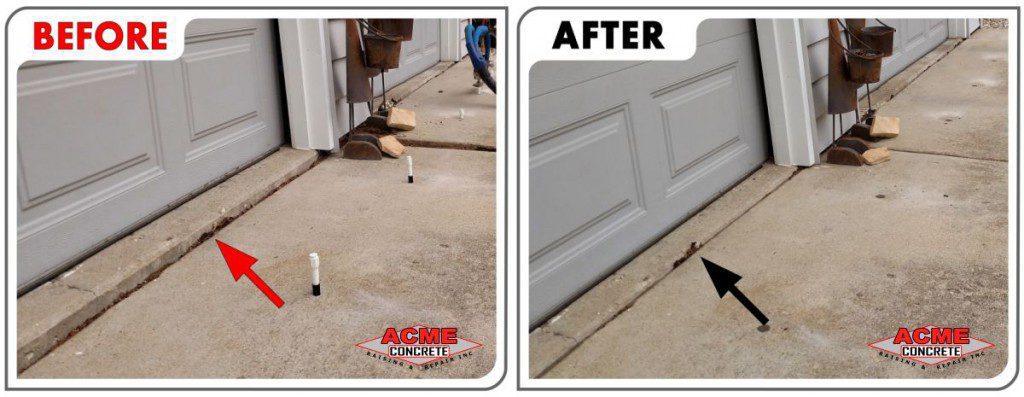
A Crystal Lake homeowner called about a driveway section at the garage that had cracked and settled about two inches. The drop created a jarring bump and a pitch change that trapped water against the garage, increasing the risk of washout beneath the slab. Acme Concrete Raising & Repair recommended a polyurethane lift to restore height and drainage.
What Our Estimator Looked For
Technicians assessed the slab edges, joint conditions, and where water was collecting. The goal was twofold: eliminate the entry bump and re-establish positive drainage away from the garage so water no longer pooled at the door.
Our Polyurethane Lift Plan
Acme’s team used small, precisely located injection points to deliver expanding polyurethane under the slab. This modern method is part of our core Concrete Raising & Leveling service and is well suited for residential driveways because it adds support while lifting, with minimal surface disruption.
The Big-Slab Difference: Support Holes Matter
For larger panels like driveway sections, it’s not enough to drill only along the dropped side. That can create a “hinge” at the lift line. We step back from the low edge and add support holes to distribute lift and create a broader bearing platform beneath the slab. This stabilizes the whole panel, reduces flexing at cracks and joints, and helps ward off renewed settlement—especially where runoff previously caused erosion.
Results You Can Feel (and See)
Once lifted, the garage approach became smooth to drive over again and the slab’s pitch carried rainwater away from the structure. The repaired panel blended neatly with the surrounding concrete, and the homeowner regained a safe, even, and better-draining driveway.
Why Homeowners Choose Acme for Driveway Panels
Acme focuses on long-term panel stability, not just a quick edge lift. Our driveway solutions are purpose-built for garage approaches and slab-on-grade panels; explore our dedicated page on Concrete Driveway Leveling for typical applications and results. For an overview of our process innovations, see our Smart Lift System.
FAQs
How does polyurethane concrete raising work for driveway slabs?
Technicians drill small injection points and introduce expanding polyurethane foam beneath the slab. As the material expands, it fills voids, adds bearing support, and lifts the concrete back to a stable, even position, which helps restore proper drainage and driving comfort.
What causes driveway slabs to sink near garages in Crystal Lake, IL?
Common culprits include water runoff toward the garage, downspout discharge near joints, and soil washout or consolidation beneath the slab. Freeze-thaw cycles can worsen voids over time, allowing panels to drop and crack.
Will lifting the driveway help with pooling water by the garage door?
Yes. Re-establishing the correct slope redirects water away from the garage, reducing ponding and the erosion that can lead to future settlement. Correct drainage also helps protect joints and the surrounding base soils.
Is polyurethane better than traditional mudjacking for driveways?
Many homeowners prefer polyurethane because it is a modern, targeted lifting method with small injection points and a clean finish. To compare methods in more detail, see Acme’s guide to Polyurethane Foam Concrete Raising vs Mudjacking.
Can cracks be addressed during the driveway leveling project?
If cracks remain after lifting, they can often be filled and sealed to limit water intrusion. Sealing joints and cracks helps keep water out of the base material and can support long-term slab stability.
Ready to eliminate that garage bump and send water the right way? Acme Concrete Raising & Repair can assess your Crystal Lake driveway and lift it with clean, durable polyurethane.